
← WorldviewRisk · Innovation · Culture
Essay
All Life Is Problem Solving
Karl Popper’s idea, and why it became my creed.
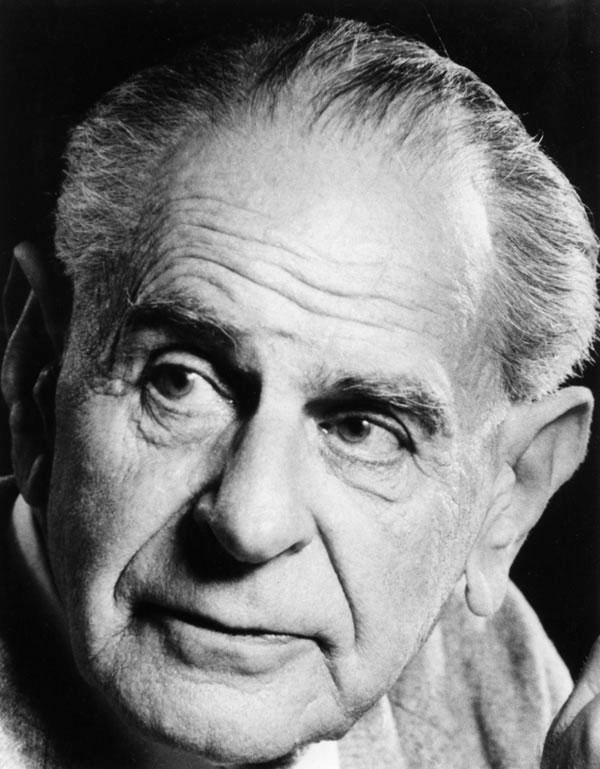
Born in Vienna in 1902, Sir Karl Raimund Popper became one of the twentieth century’s most influential philosophers of science. He is best known for falsifiability: a scientific theory must allow for evidence that could show it to be wrong, and an explanation earns credibility by surviving serious attempts to challenge it. In The Open Society and Its Enemies, he also defended democracy and the freedom to criticise authority. (Stanford Encyclopedia of Philosophy)
In 1991, Popper gave a lecture in Bad Homburg to the German automotive industry association. Titled All Life Is Problem Solving, it later lent its name to a collection of his essays.
His argument linked nature and technology in concrete terms. Bees store food; humans build food storage systems. Organisms possess ways of meeting the difficulties of survival; people invent tools and systems to meet their needs. The difference lies in method. Biological evolution eliminates unsuccessful variations; humans can deliberately examine a solution, find its weaknesses and improve it. Error correction connects the two, and criticism is how we discover where an attempted solution falls short.
Popper welcomed criticism of technology’s mistakes, but not the rejection of the very means to correct them:
It is important to draw attention to the little-noticed mistakes that we make. It is understandable that these mistakes are often exaggerated, and perhaps this is necessary to gain a hearing. But to attack science and technology as a whole, when they alone permit the necessary corrections to be made, is not only stupid but sensation-seeking and completely irresponsible.
— Karl Popper, All Life Is Problem Solving, translated by Patrick Camiller, Routledge, 1999, chapter 9, p. 101.
What I take from it
Every facet of life is continuous problem solving. A problem can be a failure demanding attention. It can also be something that works yet remains inconsistent, expensive, slow or incomplete. Something can work and still leave room for a better answer.
That room matters to me.
To improve a system, you must first understand it: its parts, how they relate, how its processes work. If you don’t understand the problem well enough, you won’t be able to fix it. That is why facts matter: they separate what is actually wrong from what merely appears wrong. Truth can set us free by showing which errors and imperfections need fixing. Fixing an imagined error is wasted effort.
Risk, innovation and culture
I see this tension in risk management. Some risk managers resist quantitative methods with familiar rhetoric such as “paralysis by analysis”. They favour innovation guided by heuristics over systematic investigation, and cultural explanations drawn from personal impressions over a disciplined study of people, behaviour and institutions.
Some may see this as an obsession with perfection, being hard to please, or showing off knowledge. That misses the point. Strip a system down to its most basic logic and you reveal its first principles, the underlying reasoning Elon Musk likes to talk about. Then you can question why things work as they do, and whether they could work better.
Past, present and emerging
Yesterday’s solutions can be improved and scaled today. New problems appear every day and need attention before their costs accumulate. Others are still taking shape: future problems we need to anticipate and prepare for. We call them risks.
Hence, all life is problem solving. Peace is problem solved. Happiness is the reward earned from problem solved.
My creed
My life’s mission, my conviction, my creed, is to make problem solving itself better, smoother and less onerous.
So this is how I choose to contribute. I watch institutions, companies, regulators and communities wrestle with problems—past, present and emerging. When one fascinates me, I seek a paying customer to put an answer to the test. I bear the cost of trial and error until the solution works in practice and earns its keep. Then I follow the next question.
Write to me about it: Discourse ›